
Let me tell you about the worst question I have ever failed to answer.
A good engineer, genuinely good, four years in, the kind who quietly fixes things nobody asked her to fix, sat down across from me and asked what she needed to do to make Senior.
And I gave her the answer. You know the answer. Everybody in this industry has given this answer or received it, usually both. I said: keep doing what you're doing, take on more ownership, show more leadership, and we'll revisit at the next cycle.
Every word of that is true. Not one word of it is useful. I had just told a person standing at the bottom of a mountain that the way up is to go up.
She left eleven months later. She is a principal engineer somewhere else now, which is roughly what she was doing for us, just without the title or the pay. And the thing I remember is not that she left. It is the face she made when I answered. It wasn't anger. It was recognition, the small tired look of somebody confirming a thing they already suspected.
There was no path. There was an escalator.
An escalator is a wonderful machine for moving people who don't need to be anywhere in particular. It is a terrible machine for climbing a mountain, and an unforgivable one to paint on the wall and call a career.
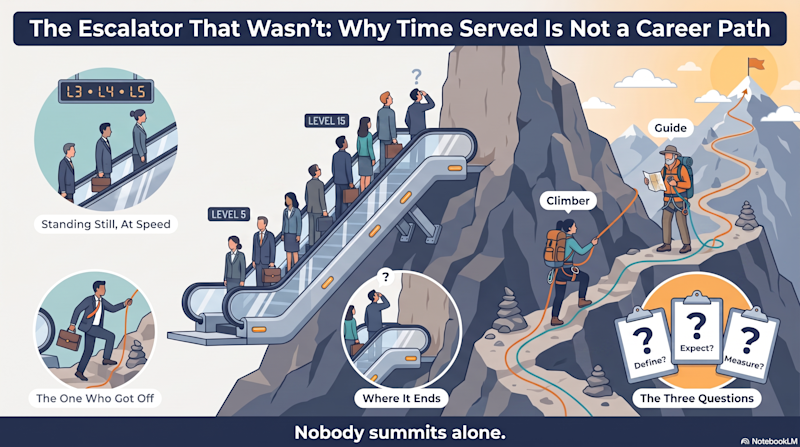
What the escalator actually is
The Escalator is not a policy. Nobody wrote it down. Nobody would defend it out loud. It is the quiet belief, baked into how most technology organizations behave, that time served moves people upward automatically, that if somebody stays long enough and nothing goes badly wrong, the title eventually arrives.
You can spot it by its symptoms.
Promotion happens once a year, in a room the candidate isn't in, based on who advocated hardest. "Senior" means "has been here a while and we like them." Nobody can tell you the difference between a mid level engineer and a senior one without using the words scope, impact, or ownership, and nobody can define those words without using each other. The performance conversation is a retrospective feeling, delivered annually, about a year nobody took notes on.
And then the tell, the one that gives it away every time. When somebody asks what specifically would I have to be able to do, the honest answer is that no one has ever written it down.
That is not cruelty. Most of the people running these systems are decent, overworked, and doing what was done to them. But it means the organization has quietly outsourced its most important product, the growth of its own people, to luck, tenure, and whoever happens to be loudest in the calibration meeting.
Standing still, at speed
Here is the thing about escalators that makes them such a precise metaphor, and then I promise to stop enjoying myself.
An escalator moves you without you moving. That is the entire appeal. And for a while it feels indistinguishable from progress. The scenery changes, the floor numbers go up, you are demonstrably further along than you were.
Then it ends. And where it ends is nowhere near the summit, because escalators are built for lobbies, not for mountains. The people who ride longest are frequently the people who have grown least, because nothing on that ride ever required them to. Meanwhile the person who could see the rock face coming got off, found a mountain with a real route on it, and started walking.
I wrote a while back about the human cost of badly shaped technology organizations, that the best people leave first because they are the ones with somewhere else to go and the clarity to know when to use it. This is the same wound viewed from a different angle. Your strongest people are the ones most capable of noticing that the path isn't real. That is not a retention problem you solve with a bonus. It is a structural absence you solve by building a route.
The three questions nobody can answer
At GSD we have had a version of this conversation with a great many organizations, and it always comes apart on the same three questions. Ask them of your own shop right now. Don't ask HR. Ask somebody who has been there three years and would like to still be there in five.
One: how do we define the path? Not the ladder of titles. Anyone can print titles. The actual route. What are the real jobs here, and what does the terrain look like between where somebody is now and where they would like to be?
Two: how do we set expectations? If a person wants to know what good looks like at the next level, is there a document, or is there a manager's opinion? Because one of those is a map and the other is weather.
Three: how do we measure? When somebody says they have grown, what changed? What behavior exists now that did not exist eighteen months ago, and how would a third party confirm it without taking anyone's word for it?
Most organizations cannot answer any of the three. Not badly. At all. And I want to be clear that this is not because the questions are unanswerable. They are eminently answerable. It is that answering them is unglamorous structural work, and structural work never wins the quarter.
Careers are expeditions
So let me offer the replacement metaphor, since I have spent a thousand words abusing the old one.
An expedition has a route, chosen deliberately from among several, knowing what each one demands. It has a map of terrain that other people surveyed and wrote down, so that every party does not rediscover the same crevasse. It has altitude markers, so you know where you are without arguing about it. It has a guide who has been higher than you and whose job is your progress, not their own summit photo. It has a party, because the composition of the rope team determines what is survivable. And it has weather, which nobody controls, which is exactly why you manage the things you do control instead.
Every one of those is buildable. That is the argument of this series. Not that careers should feel more meaningful, but that they should be engineered, with the same seriousness you would bring to a delivery pipeline, because the people are the delivery pipeline.
Five things, foundational by design
Same annoying habit as always. Five things, one essay each, and they share the property that you cannot bolt them on afterward.
You choose the party on purpose. Hiring against a defined mission, named outcomes, and the competencies the climb actually requires, instead of against a résumé and a warm feeling in the room. Who you rope in determines everything downstream. (Part 2.)
The map is written down. What your organization knows exists as a shared, navigable structure, not as folklore living in the heads of six people, two of whom are interviewing elsewhere. (Part 3.)
Better has a language. A small set of core jobs with defined levels of behavior, and acceptance criteria for what competence means, so growth is something you can observe rather than something you assert in a calibration meeting. (Part 4.)
Somebody is guiding. Leaders who care visibly and consistently, who manage the process because the outcome was never fully theirs to control, and whose people never have to guess where they stand. (Part 5.)
It compounds, or it evaporates. Every expedition either teaches the organization something it keeps, or it doesn't, and you relearn the same lesson forever with a new cohort. (This one runs underneath all of it.)
Notice what is not on that list. Perks, ping pong, a fresh title taxonomy, and an engagement survey. Those are the kitchen. This is the footings.
Before you plan the climb, look at the trailhead
You already know which one your organization has. You do not need me for the diagnosis. You need me for the nerve to say it out loud.
You know whether a person on your team could describe their next level in behaviors rather than adjectives. You know whether "how do I get promoted" has an answer that survives contact with a follow up question. You know whether your last three departures were people who had stopped growing, and whether anybody noticed before the resignation.
If you don't know, and most don't, that is not a character flaw. It is an unmapped route. The fastest way GSD has found to draw the real map is the Maturity Assessment, which looks at the People dimension the same way it looks at everything else: at behavior, not at intentions. Where do your teams actually sit? What do your roles actually require? You find the gaps first. Then you close them. In that order. Always in that order.
Over the next six weeks we will walk the whole route: the party, the map, the markers, the guide, and the playbook you can start on Monday.
For now, just go find out whether the thing your people are standing on is a path or a machine.
She knew within eleven months. They always do.
Nobody summits alone.
Next in the series, Part 2: "Choosing the Party: Hiring for the Climb, Not the Résumé."
*Curious whether your people have a real route or a painted one? GSD's Maturity Assessment is the entry point, a structured look at where your delivery organization really stands, people included, before you invest in closing the gaps.*
Back to Blog