
We've spent five essays walking the build site. We met a man with a nail gun and no blueprint. We learned that the most expensive thing in software is building the wrong thing efficiently. We met the Magic Intern, taught it to wear a leash, did the honest arithmetic on what it costs, and built the kind of building you're happy to show the inspector.
Diagnosis is the easy part, though. Any grump can tell you what's wrong, I've made a career of it. The harder, more useful thing is telling you what to do Monday morning. So here it is: no metaphors I haven't already worn out, just the order of operations. A builder's playbook.
The best time to build on solid ground was before you bought the robots. The second best time is Monday morning.
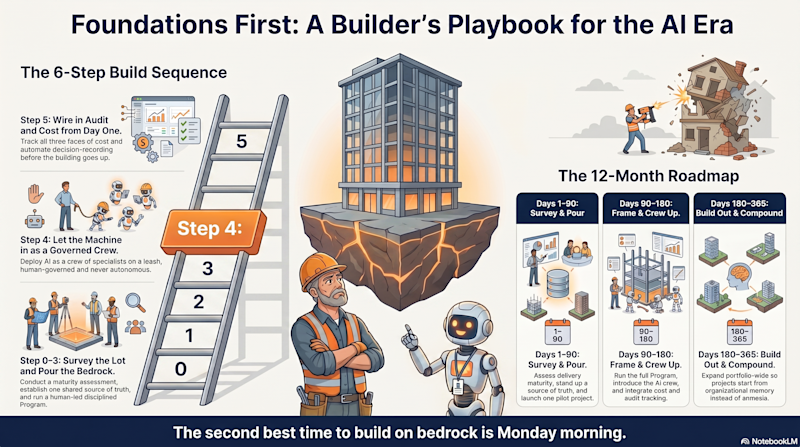
The steps, in the only order that works
Step 0: Don't touch the AI yet.
I know. You bought it, your competitors are bragging about it, and the board wants to hear the word in the next earnings call. Resist. The single highest-return decision in this entire playbook is the discipline not to point a fast machine at an un-surveyed lot. Step 0 isn't a delay. It's the thing that makes every later step worth taking. Survey before you build.
Step 1: Find out where you actually stand.
You can't fix a foundation you've never inspected, and you cannot self-assess your way to an honest answer, everyone grades their own delivery org on a curve. Get an outside read on the real gaps: Is there a Program, or just a backlog? Does the machine wear a leash, or run on luck? Do you steer cost or receive it? Does your evidence exist, or get assembled in a panic? This is precisely what GSD's Maturity Assessment is for, a structured, behavior-driven look at where your delivery org really sits, before you spend a fortune fixing the wrong wall.
Step 2: Pour the foundation: one source of truth.
Before anything clever, build the boring foundation from Part 2, one shared, living record where the original idea and the shipped code point at each other, where every claim is distilled rather than dumped, and where every claim carries its origin. Everything else in this list stands on this. Skip it and you're framing the second floor over open dirt.
Step 3: Run the Program before the robots.
Install the blueprint discipline from Part 2: vision, objectives, the shape of the problem, the breakdown, honest sizing, a real roadmap, with a human signature between each phase and the next. Humans decide what; the machine helps with how. Get this rhythm working with your people first, so that when you add AI, you're accelerating a process that works instead of automating one that doesn't.
Step 4: Now let the machine in, on a leash, as a crew.
Only now. Bring in AI the way Part 3 describes: not one godlike robot, but a crew of checkable specialists with a human foreman and a hard rule that nothing ships on a robot's say-so. Start where the work is high-volume and cheap to verify, let the intern earn trust on the easy stuff before you hand it anything that matters.
Step 5: Wire in the meter and the inspector from day one.
Cost visibility (Part 4) and first-class audit (Part 5) are not Phase 2. They are not "once we've proven value." They are foundations, which means they go in before the building, not after. Track all three faces of cost from the first request. Make every decision record itself from the first decision. Do this now, while it's a small habit, instead of later, when it's an excavation.
Notice the shape of that list. The AI shows up at Step 4 of 5. That is not an accident, and it is not me being a Luddite. It's the entire argument of this series compressed into a sequence. The machine is the most powerful tool on the site. You still pick it up fourth.
The roadmap: a year, honestly
Steps are nice. Calendars are better, because "we'll get to it" is where good intentions go to die. So here's a year, roughly, for an organization starting from the usual place.
Days 1–90: Survey and pour. Get the honest assessment. Don't argue with the results, fund them. Stand up the single source of truth and get your people distilling knowledge into it instead of dumping it into a swamp. Pick one real project as your pilot. Resist the urge to boil the ocean; you're proving a foundation, not winning a press release.
Days 90–180: Frame and crew up. Run the full Program on the pilot, gates and all. Then, and only then, introduce the AI crew on the easy, checkable work. Wire in cost tracking and self-recording audit as you go, so they're load-bearing from the start rather than retrofitted later. Measure everything. Compare the machine to the human, all three faces, and let the numbers, not the hype, not my grumbling, tell you where AI genuinely wins.
Days 180–365: Build out and compound. Expand from the pilot to the portfolio, carrying the foundations with you to every new project. This is where solid ground pays off: each project starts from the organization's accumulated knowledge and memory instead of from amnesia, each one cheaper and surer than the last. Your shop stops relearning the same lessons forever and starts actually getting smarter. That compounding, not raw speed, is the real prize. Speed without foundations just gets you to the wrong place sooner.
The final dare
I'll leave you the way I always do, with a question you already know the answer to, you've just been avoiding it.
Walk your build site one more time. Can you trace a line of shipped code back to the objective that asked for it? Can you say what last week's AI actually bought? If the inspector knocked tomorrow, would you reach for a query or for the phone?
You know which it is. Everyone knows which it is. The only thing separating the shops that thrive in the AI era from the ones that generate magnificent rubble at unprecedented speed is whether they had the nerve to pour the foundation before they picked up the fastest tool ever invented.
It is not a technology problem. It never was. The machine is ready. The question is whether your organization has the discipline to use it effectively, to run the right Program, govern the machine, count the cost, and welcome the inspector. To build on solid ground instead of on sand and a press release.
That discipline is buildable. It starts with one honest look at where you stand and GSD's Maturity Assessment is the entry point, the fastest way to find the gaps before you spend a fortune closing the wrong ones.
The man with the nail gun is still out there, by the way. Still fast. Still framing bathrooms in living rooms. Still wondering why the second floor keeps ending up on the first.
Don't be the man with the nail gun.
Pour the foundation. Then build something that stands.
Measure twice, prompt once.
— Gerhart S. Dunn
This concludes "Building on Solid Ground." Parts 1–6: the Build Site, the Program, the Machine, the Bill, the Inspector, and the Playbook.
*Ready to find out where your foundation actually sits? GSD's Maturity Assessment is the entry point — a structured, behavior-driven look at where your delivery org really stands, and the fastest way to find the gaps before you invest in closing them.*
Back to Blog